Codes Error RCSDASSK
You’re working in your software environment, everything seems fine then suddenly a strange string appears: codes error rcsdassk. No clear explanation. No obvious cause. Just a cryptic message sitting between you and your work.
This happens more often than people admit. Error codes like this one can appear in log files, during software builds, inside API responses, or while running automated scripts. The frustrating part is not the error itself it’s not knowing what it means or where to start.
This article will walk you through exactly what this error code means, the common reasons it shows up, and the most practical ways to resolve it. Whether you’re a developer, a system admin, or just someone trying to get their software working again, this guide is written for you.
Codes error rcsdassk is a system or application-level error identifier that signals a failure in a software process typically related to authentication, session handling, or data routing. It acts as a unique error tag that helps developers trace where and why a specific operation broke down inside a software pipeline or connected service.
Quick Summary
Codes error rcsdassk is a software error code that usually points to a breakdown in a system process like a failed connection, bad session token, or misconfigured routing. It’s fixable. This guide shows you how.
Why Error Codes Like RCSDASSK Exist
Software doesn’t fail silently at least, it’s not supposed to. When something goes wrong inside a program, the system generates an error code to mark exactly what happened and where.
These codes serve as labels. Instead of writing out a full sentence explaining the failure every time, the system drops a short identifier into the log. Developers and tools can then look up that identifier to understand the root cause.
The code rcsdassk follows this same logic. The string itself is unique likely generated by a specific platform, SDK, framework, or internal system. It’s the system’s way of saying: “Something broke here. This is the reference point.”
Understanding error codes in general makes you a better troubleshooter. Once you know how to read them, you stop guessing and start solving.
Where This Error Typically Appears
Before you can fix it, you need to know where to look. The codes error rcsdassk typically shows up in the following places:
1. Application Log Files
Most software systems write errors into log files. If you’re running a server-side application or a backend service, check your /logs folder or your logging dashboard first. The error will often appear with a timestamp and a stack trace.
2. API Response Bodies
If you’re building or testing an API integration, this error may appear inside the response payload. Something like:
JSON{
  "status": "error",
  "code": "rcsdassk",
  "message": "Request could not be processed"
}
That’s a sign the request reached the server but failed during processing.
3. Build or Compilation Output
In some development environments, especially those with strict validation layers, this code can surface during a build process when the compiler or packager encounters an unexpected state.
4. CI/CD Pipeline Alerts
Teams using continuous integration tools like GitHub Actions, Jenkins, or CircleCI may see this code appear in pipeline failure notifications when a deployment or test run hits an unexpected error condition.
Common Causes of Codes Error RCSDASSK
Knowing the cause is half the battle. Here are the most common reasons this error appears:
Session Token Expiry or Corruption
One of the most frequent causes is an expired or malformed session token. If your application relies on authenticated sessions and the token becomes invalid due to timeout, tampering, or encoding issues the system throws an error to block the operation.
Example: A user in Chicago logs into a SaaS platform, leaves their session idle for two hours, then tries to submit a form. The session token has expired. Instead of refreshing silently, the system throws the rcsdassk error code and blocks the submission.
Misconfigured Environment Variables
Modern software applications rely heavily on environment variables things like database URLs, API keys, and service endpoints. If one of these is missing, misspelled, or pointing to the wrong environment, the system can’t route the request correctly.
This is especially common when developers move code from a local setup to a staging or production environment without updating the .env file properly.
Dependency or Version Mismatch
If your project uses libraries, packages, or SDKs that are out of sync with each other, you’ll start seeing unexpected error codes. The software tries to call a function that no longer exists in the updated version and fails.
Running npm audit, pip check, or the equivalent for your stack can help catch these conflicts quickly.
Failed Data Validation at Input Layer
Some systems generate unique error codes when incoming data doesn’t match the expected format or schema. If a user sends a request with a missing field, a null value, or an unsupported data type, the validator blocks it and returns an error like rcsdassk.
This is actually a feature, not a bug but it means you need to check what data you’re sending and confirm it matches what the system expects.
Network or Service Interruption
In distributed systems and microservice architectures, one service talks to another. If that second service is down, slow to respond, or returning an unexpected result, the first service may log the failure using a specific error code like this one.
This is common in cloud environments where services depend on external APIs, databases, or third-party integrations.
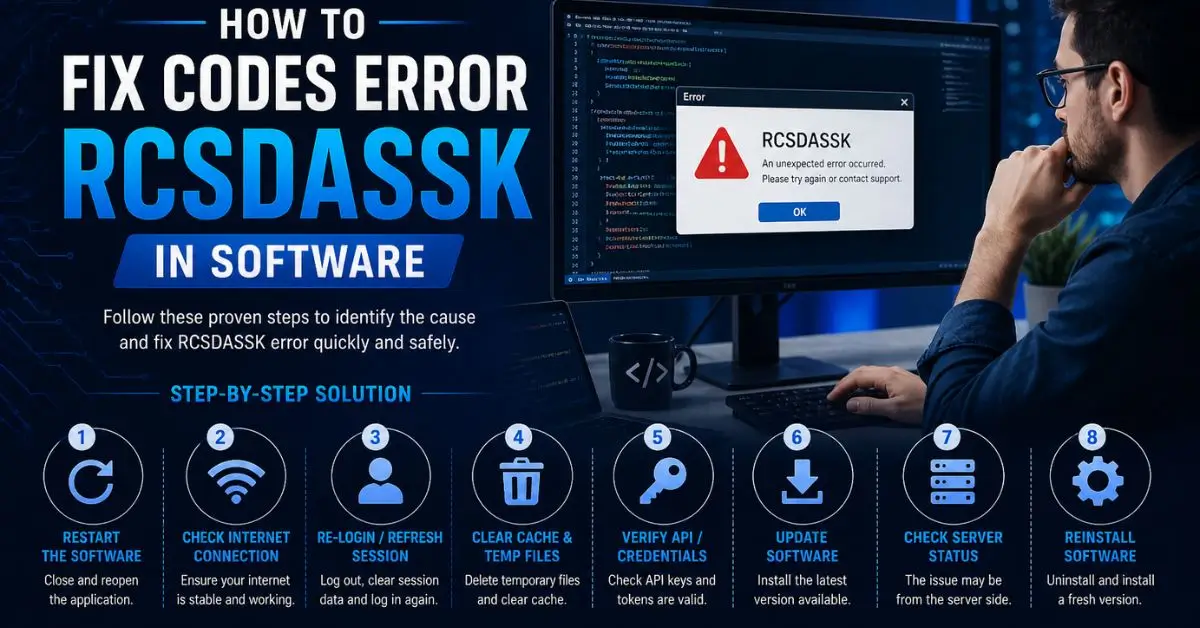
How to Fix Codes Error RCSDASSK – Step by Step
Now let’s get practical. Follow these steps in order. Most users resolve the issue within the first three steps.
Step 1: Read the Full Error Log
Never just look at the error code alone. Always scroll up or down in the log to find the full context. Look for:
- What action triggered it
- Which file or function was active
- What line number is referenced
The code is just the headline. The log body is the full story.
Step 2: Check Your Authentication State
If the error appears after a user action or API call, verify that the session or access token is:
- Still valid (not expired)
- Correctly formatted
- Included in the request headers
If you’re using a JWT or OAuth token, decode it using a tool like jwt.io and check the expiration field (exp).
Step 3: Verify Environment Variables
Open your configuration file or environment settings and confirm:
- All required keys are present
- No typos in variable names
- The values match the target environment (dev, staging, production)
A single missing quote or misplaced underscore can break everything silently.
Step 4: Check for Dependency Conflicts
Run your package manager’s audit or check command:
- Node.js:
npm installthennpm audit - Python:
pip check - Ruby:
bundle check
Update any outdated packages carefully, and test after each change.
Step 5: Test the Network or Downstream Service
If the error is happening in a service-to-service call:
- Ping or test the downstream API directly using a tool like Postman or curl
- Check if the external service is experiencing downtime (look at their status page)
- Review timeout settings in your request configuration
Step 6: Isolate and Reproduce the Error
If none of the above resolves it, try to reproduce the error in a controlled way:
- Strip away extra logic
- Send the simplest possible request
- Add console logs or debug breakpoints at key points
Isolation is one of the most powerful debugging techniques available. It forces the problem to reveal itself.
Step 7: Consult Documentation or Support
If the code is coming from a specific platform, SDK, or third-party service, check their:
- Official documentation
- Developer forum or community (Stack Overflow, GitHub Issues)
- Support portal
Many platforms maintain error code reference pages where you can search for specific identifiers like rcsdassk and find official guidance.
Helpful Comparison: Error Sources and Fixes
| Error Source | Likely Cause | First Fix to Try |
|---|---|---|
| API Response | Bad token or missing auth header | Refresh token, check headers |
| Build Output | Dependency version mismatch | Run package audit, update deps |
| Log File | Environment variable missing | Check and update .env file |
| CI/CD Pipeline | Service unavailable or timeout | Check downstream service status |
| Form Submission | Invalid input data | Review input schema and validation rules |
Best Practices to Prevent This Error in the Future
Fixing the error once is good. Making sure it doesn’t come back is better.
- Use structured error logging: tools like Sentry, Datadog, or LogRocket give you clear context around every error, not just the code
- Validate inputs early: catch bad data at the entry point before it travels deeper into your system
- Set proper token expiry handling: build refresh logic into your authentication flow so sessions don’t die silently
- Keep dependencies updated: schedule regular dependency reviews, not just when something breaks
- Document your environment setup: a clear README or env template reduces configuration errors when deploying
Conclusion
Error codes are frustrating but they’re also useful. When you understand what they’re pointing to, they stop being obstacles and start being directions. The codes error rcsdassk is no different. It’s your system saying something specific went wrong in a specific place. Your job is to follow the signal.
Work through the steps in this guide, start simple, and don’t skip the logs. Most of the time, the answer is already there you just need to know where to look.
If this guide helped you, share it with your team. One person’s solved error is another person’s saved hour.
Frequently Asked Questions
What does codes error rcsdassk mean?
It’s a software error identifier that signals a failure in a system process usually related to authentication, data validation, or service communication. It appears in logs or API responses to help developers trace exactly where something broke down.
Is codes error rcsdassk a serious error?
In most cases, no. It’s typically a recoverable error pointing to a configuration issue, expired session, or failed connection not a system crash. Most developers resolve it within minutes using basic troubleshooting steps.
Can it appear in any programming language?
Yes. This error isn’t tied to one language. It’s usually generated by a platform or service layer. Whether you’re using JavaScript, Python, or Java, the fix approach stays the same check logs, verify config, isolate the cause.
Why do error codes use random-looking strings?
They’re unique identifiers designed to avoid conflicts with other error codes. Some are hash-based, others are assigned during development. The goal is traceability, not readability.
How long does it take to fix?
Simple causes like expired tokens or missing variables minutes. More complex issues like dependency conflicts or microservice failures a few hours. Most cases are resolved quickly with a clear, step-by-step approach.
About the Author